
February is increasingly known as the month of love, with Valentines Day as a big initiator for this phenomenon. I thought, it would be too easy to choose the topic love for this month’s collaborative article… Hence, this month, the Skilled Helpers Collaborative share their individual perspectives regarding the topic Communication…
Communication
by Sukeshi Pandit Malhotra
“Great communication begins with connection” – Oprah Winfrey
The need for connection & belonging is one of the core fundamental needs for human survival, following closely behind the basic physiological needs, like food, water, shelter & security. Right from the time we are born, our lifelong quest to connect, interact & communicate with entities in our environment begins. We have a deep desire to be in healthy wholesome relationships and communication is the key to that. Communication fulfils the need to be emotionally nurtured, to comprehend, connect and make sense of the world around us, to enhance & exchange knowledge, to influence others & be influenced by their thinking, to find solutions to problems & to create a shared reality.
Communication, be it on a personal or professional level, often involves a negotiation of power…will this cost me power, will I lose power to this person, how do I keep a balance between giving in and holding my own. Communication becomes our main tool to control relationships & to serve other interpersonal goals.
Intra personal Communication (Self-talk, Self-concept, self-love)
The first & most critical connection/communication we have is with ourselves. This quote from Brene Brown pretty much sums up the relevance of connection to the self – “Our connection to other people is only as solid and deep as our connection to ourselves. In order for me to be connected to you I have to know who I am. And I think what we end up doing is desperately seeking to connect to other people when we have no idea who we are.”
The precursor to connection with ourselves is our level of self-awareness, how attuned we are to our inner world…beliefs, thoughts, motivations, compulsions, feelings & emotions. Our inner environment manifests through the words we use to communicate with ourselves. My self-talk sets the tone for my relationship not only with myself but with everyone around me.
Some things to reflect upon to make our intra-personal communication healthy & dynamic:
- How respectful & compassionate am I towards myself?
- Am I honest about my strengths & weaknesses?
- What is holding me back? Am I in denial of something & why so?
- What will it cost me to be authentic?
- What is the underlying fear/shame? Am I afraid of loss of power?
- What will it take for me to be vulnerable/comfortable in my skin?
- What measures can I take to enhance my sense of self-worth?
How we use our inner voice to navigate our way around problem solving, conflict resolution and judgements will define our success in forging healthy relationships both in personal & professional capacity. Intrapersonal communication is considered by many, as the most important job skill for success.
As a personal transformation Coach, I have worked successfully with people to help them establish a robust & healthy sense of self-worth through various coaching tool from the CBT & NLP disciplines.
Interpersonal Communication
The next level is interpersonal communication which serves different purposes, based on our needs – within personal relationships, in professional capacity, in social interactions, friendly collaborations, banal banter & many more, each one requiring a different skill-set, medium of communication and level of depth.
Here are some factors critical to create a safe space for effective communication, so both parties feel seen & heard, and an open conversations can be had to arrive at some common ground:
- Be Present – Bring 100% of yourself into the interaction so they feel they have your full attention; do not allow distractions like a buzzing phone or other external disturbances
- Positive body language & mirroring – facial expression, eye contact, body language, posture A large part of the communication happens through the nonverbal body language; use mirroring technique, follow the cue of the person & mimic their movements & postures to create a bond & connection with them
- Conscious listening – The art of developing more satisfying connections begins with active listening; Be attentive and listen to understand their POV, don’t jump in with suggestions, the person should feel seen & heard
- Feedback – Repeat back what you hear from time to time to ensure you have the facts right
- Open Mind – Be non-judgmental, keep your biases aside, do not go with pre conceived perceptions of right & wrong; don’t hold a moral high ground, Be flexible
- Empathy – Bring appreciation, compassion & forgiveness for them as well as yourself,
- Be vulnerable – allow yourself to be vulnerable; real conversations happen only when we allow our authentic selves to show up
World of Virtual Communications
With the advent of the internet era & global social media platforms, interpersonal communication has acquired a highly complex & dynamic outreach, form & language of expression.
While the traditional forms of communication required a physical presence & personal involvement, the virtual world allows personal interactions with global access. One can communicate with anyone, anywhere in the world sitting right at home in your PJs, having the most profound discussion on any subject or attend a job interview, or an exec meeting. This form of communication has made it possible to make connections, exchange ideas, share information & learn new concepts like never before. All you need is an open mind, a laptop and an internet connection. Personally, I have found some great avenues to connect & communicate with people from around the world, an opportunity not easily available through in-person interaction.
On the flip side, the social media interactions come with complete anonymity & zero accountability in most cases, making it easy for people to display their ugly, judgmental, negative side with zero accountability. We need to find ways to tackle that in the future. With great freedom comes great responsibility…as the saying goes!
Communication is the corner stone of human interaction & we are lucky to be living in an era where technology has made communication extremely accessible & affordable. We just need to embody the maturity to handle it with grace & dignity.
Connect with Sukeshi Pandit Malhotra, Personal Mastery & Transformation Coach, via sukeshipm @ gmail.com
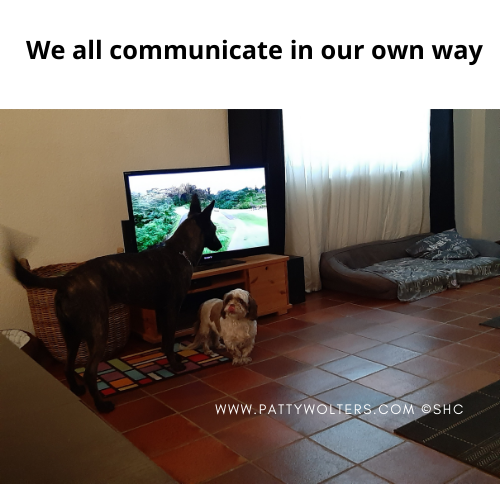
Giving Space
by Rika Cossey
“…and, of course, I recycle,” she concluded her monologue.
I couldn’t help but roll my eyes.
The question had simply been how she had watched the news last night and she ended up giving me a long speech about politics, our local community, and climate change. Or rather, I should say, she ranted at me for about 15 min that no one was doing anything. In her eyes, so much needed to be done but no one was doing it.
I have grown tired of the same old demand stories because I hear them all the time. Yes, there is a lot that needs to be done and sometimes all those tasks are overwhelming.
No, I need to correct myself: often those tasks are overwhelming.
I have had my share of anxiety and guilt. I also felt that what I was doing wasn’t enough and that others needed to do more. I’m also one to shift my responsibility onto others and throw my hands in the air.
Or, on other days, I take pride in the list of things I was doing to live more sustainability.
As I looked at her, obviously exhausted by her own demands, I decided to try something with her. I had read this in a book recently and thought it could work with her.
“Why do you say that you recycle?” I asked her. The question seemed to startle her.
“What do you mean?”
“Well, we all recycle, right? I mean we have to otherwise we get fined. But sometimes I’m just so tired of it and wonder what it would be like if I didn’t recycle. Like, what would that actually mean to me?”
She gave me a blank stare and then her eyes started to look upwards. She was thinking, looking for solutions. This was getting interesting, I thought to myself. I waited and stayed silent.
“I don’t know,” she started. “I guess it would be easier, right? I mean, it would reduce the number of bins in the kitchen. And you would only take down one bag to one bin. I mean it would make things a lot easier. But I don’t know. It’s normal, right? I mean, you recycle. That’s just it. We all do our part, I guess. It’s been around for so long, I don’t know what it would be like if we only had one bin. And, to be honest, it’s kind of cool to know you’re doing something. I mean, there is so much that needs to be done but when you recycle, you do something. I kind of like that. It feels like I can do it. I mean, it’s not that hard. I just put my rubbish in the right container. It’s easy. I like it.”
Her eyes started to wander again and I stayed silent, just nodding here and there.
“And,” she continued, “I guess, it means that I’m doing my part. It’s important. I don’t feel like I can do much else but that I can do.”
She sounded content with herself and smiled. But I wanted more.
“But if recycling is already so easy, wouldn’t it also be easy to eat less meat? I mean, you always say how you want to watch what you eat and there are so many YouTube videos with meat-free recipes. Wouldn’t that also be possible?”
“Are you getting political on me now?” She was getting defensive and I bit my tongue. I knew this was going to be a sensitive topic. No one liked it when I questioned their food choices – no, life choices. Recycling seemed easy enough but food was too personal. Or was it?
She had been silent, her eyes wandering again. She was thinking about it. “You know, there is this YouTube channel that I quite like and I think he sometimes cooks without meat as well. I always wanted to try that. And there is this cool-looking bistro around the corner from my work that’s apparently vegan. And my colleague told me about this new frozen mince meat that’s not really meat.”
Her talking speed increased and she seemed to get excited.
“She said it tastes like it though. It sounded interesting. I do want to cook more for myself. I don’t like all the takeaway food we always get. It’s getting boring. I sometimes just want to munch on a carrot. It’s funny ey, how you suddenly just want to eat a plain carrot. Well, I get that sometimes anyway.”
She was looking out the window and wasn’t paying much attention to me anymore. She had disappeared into her own world.
I felt it was time to get back to my kids. I could hear them fighting again. I slowly pushed my chair from the table, trying not to disturb her too much.
Her gaze broke when I got up.
“Oh sorry, I kept you so long.” She sounded distracted. I didn’t mind. She looked at her watch and got up as well, putting her cup on my kitchen counter.
“Thank you for the tea. I need to get going. It was nice chatting. We should do it again someday.” She moved, rather quickly, to the front door. I stayed back, giving her space.
“Thanks again,” were the last words I heard before the door closed between us.
I smiled and just thought “Anytime”.
Connect with Rika Cossey, Climate Emotions Coach @ www.rikacossey.com
Compassionate, Courageous Communication
by Claire Rajan
*“Every problem contains the seed of its own solution.”- Norman Vincent Peale
Now, more than ever, the need to become self-aware about how we communicate with ourselves is crucial.
Divisiveness and conflict rock and split our world at many levels of human existence.
While it is easy to notice and identify such tensions (often the result of communication) on the outside, it isn’t easy to catch them within ourselves.
While we might appear “put together” and move along our individual lives, many of us can feel and experience tensions within ourselves.
I perceive this tension as a kind of “splitting from within”. In engaging in self-examination, we might be able to notice how our limitations, irrational emotions, unaware-self, unresolved trauma, inner wounds, erratic tendencies, past misgivings, inadequacies, insecurities, unmet needs, wants, desires, and unfulfilled dreams (among many others) have the potential to unsettle and rock our lives.
Let me take a moment to state that all that I have written so far can be personally elusive and yet widely prevalent.
Establishing inner coherence and congruence is much needed and far easier said than done.
Becoming self-sustainingly stable can be a painfully arduous task. It involves looking at ourselves with honesty, humility and self-compassion.
How does communication fit into this picture?
How do the words we use shape our lives?
How does our ability to listen to ourselves fit into the context of “splitting from within”?
In addition to experiencing the problem of tensions formulated by our “splitting self”, close attention also reveals the problem of inner voices accompanying the splitting.
A crisis of sorts arises from our inability to take the time to pay attention and listen to how we talk to ourselves.
Internal voices are often confusing and can be critical, shaming, bullying, fear-driven, anxious, harsh and sometimes downright hostile. They could inform us of our limitations.
On one side, we might be resistant to our inner voices, while on the other, we might listen, accepting whatever we hear within us without resistance and our conscious awareness.
A popular remedy that makes its rounds in our modern society is one of “shifting into positivity”. If not kept in check, an excess of positivity can become toxic.
In engaging positivity without awareness, we might quickly switch from internal negativity to positivity. Like an internal swing, we can move between negativity and positivity without anything to substantiate the positivity.
Words spoken with superfluous positivity come across like “Be positive”, “Look on the bright side”, “Cheer up”, “ Be Happy”, “Follow Your Bliss”, etc. Such phrases have become relatively commonplace.
If you have tried applying them, you will soon realize it isn’t sustainable to maintain a stable sense of being with such positivity.
Is there a better way, one that is more honest, honorable of our condition and sustainable over time?
Is there a way that offers a stable solution to the problem itself?
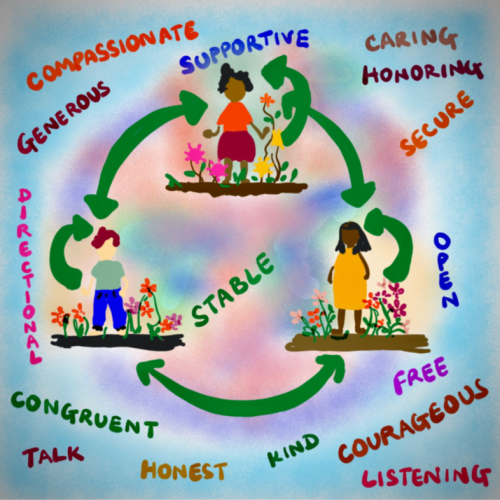
I would say there is. It takes the form of internal communication that upholds courage and compassion accompanied by conscientiousness and conscious effort.
It does not dilute or spin the internal state but remains keenly aware of what is happening without losing traction to fears and tension.
With compassion, we place our splitting state into our own “caring hands”.
We listen to the voices within from a place of nurturing, loving kindness and can formulate a plan to move forward through navigating necessary changes to improve ourselves. We do this by engaging our inner resourcefulness.
When we can view ourselves from this place of courage and compassion, we begin to communicate within ourselves differently.
With serenity, we can effectively deal with the highs and lows of our human nature. An inner grace can hold the fears, worries and anxieties generated by our limitedness. We will be able to navigate our shallowness with determination.
All of this is possible for every one of us. It requires that we investigate the vital elements of communication, namely attention, listening and speaking.
We are constantly communicating with ourselves, every moment of every day. Wouldn’t it be helpful to do so from a place of compassion and courage?
Navigating the inner terrain of our unique nature can be pretty extensive and personal. However, it is worth noting that we don’t have to live with our communication problems permanently.
We can move into a better internal place by walking through how we talk to ourselves.
The issues surrounding self-splitting will steadily shift to one of self-unifying via self-stabilizing.
Our caring inner communication, if upheld by compassion and courage, will, in turn, move forward in how we communicate with each other; this is a good thing.
Therein exists a stable solution to a prevalent problem.
Connect with Claire Rajan, Life Coach & Enneagram Coach via wisdomrocks22 @ gmail.com
Communication: it's a mindfield!
by Bernard Kates
“For millions of years, mankind lived just like the animals. Then something happened which
unleashed the power of our imagination. We learned to talk and we learned to listen. Speech
has allowed the communication of ideas, enabling human beings to work together to build
the impossible. Mankind’s greatest achievements have come about by talking, and its
greatest failures by not talking. It doesn’t have to be like this. Our greatest hopes could
become reality in the future. With the technology at our disposal, the possibilities are
unbounded. All we need to do is make sure we keep talking.” – Stephen Hawking
All we need to do is make sure we keep communicating.
Communication takes many forms. Let’s assume for the sake of argument that we’re talking about inter-personal communication. That is, communication between people. We’re doing it now, you and I.
As I write, I’m thinking about the message that I want to convey to you. As you read, you’re interpreting my words and with any luck a coherent meaning is starting to come together in your mind. This form of communication is one-way: from me to you, and I don’t have any way of knowing whether the message you receive will be the same as the one I intended to send. And so, I put my fingers to my keyboard and let my ideas flow, doing my best to use clear and concise language to make it as easy as possible for you to catch my drift.
“I know you think you understand what you thought I said but I’m not sure you realize that
what you heard is not what I meant.” – Alan Greenspan
Communication isn’t always one-way. Well, perhaps for some people it is! They’re the ones who are so full of their own importance – “everyone’s entitled to my opinion” – that they don’t care about what anyone else has to say. But for the rest of us, two-way communication, involving an exchange of ideas, is the foundation of every relationship in which we engage, no matter how superficial it may be.
Humans are a social species. Unless we’re Robinson Crusoe, all our lives we are around other people: family, friends, colleagues, acquaintances and those with whom we interact in the course of our daily routine. Communication is the art and science of our interactions with these people. It’s about how we send and receive information, thoughts, feelings and ideas to, from and between each other.
When we do that effectively, when I listen respectfully to you as you explain your point of view, and then you do the same as I explain mine, we can have a conversation: an exchange of ideas leading to mutual understanding. That doesn’t necessarily mean we’re going to agree but when we begin a conversation from a place of mutual respect we at least stand a chance that through discussion we can reach some degree of agreement, even if it’s to agree to disagree.
Giving someone the cold-shoulder, refusing to talk to them because you feel they’ve offended you in some way, is the surest way I can think of to intensify conflict and deepen resentment. It beggars belief that even now, in the 21st century, international “diplomacy” still engages in such puerile behaviour. One country does something to annoy another and, almost before you know it, ambassadors have been recalled and dialogue ceases. That is sheer stupidity. In times of disagreement, increased contact and increased dialogue is what’s needed, not the opposite.
This kind of thing – giving someone the silent treatment – happens between individuals, too. If you want a relationship to break down, just stop communicating with each other. Trust me, I’ve been there.
Relationship breakdowns, conflicts and wars all stem from one thing: a failure of the parties involved to show respect for each other by listening to each other and by failing to keep communicating even when their positions are apparently irreconcilable. War is the ultimate failure, representing an absence of communication and a return to living “just like the animals.”
If we want a world in which everyone lives in peace, “all we need to do is make sure we keep talking.”
“You may say I’m a dreamer
But I’m not the only one
I hope someday you’ll join us
And the world will be as one.”
John Lennon, “Imagine”
Connect with Bernard Kates, Transformational Leadership Coach and Mentor @ www.bernardkates.com


2 Responses
Fabulous contributions, Patty. So well written and easy to digest. Keep talking, absolutely 😊
Thank you for reading! Much appreciated <3